Ok, this was a phenomenal year for me. The vibe of the year is cleanly captured by what I had scribbled on a whiteboard on Jan 3rd, 2025.

To my amazement and giddiness, the feeling still holds up as the year wraps up. Let’s see what all kept this spirit alive.
Brief interlude: the yearly review has become a sort of an annual tradition for me. In case you’re interested, you can check out previous years’ reviews too: 2024, 2023, 2022, 2021, 2020 and the entire decade before that.
🫡 Exited Wingify
I had started Wingify in 2010 (when I was 22) and in Jan 2025 (when I was 37) exited my stake to Everstone, a private equity firm. As you can imagine, Wingify consumed the entirety of my early youth. It taught me about startups, business, leadership, human psychology and put me in contact with an incredible set of people who I’m proud to have worked with (especially my co-founder Sparsh and CTO Ankit Jain).

The news of the exit spread like wildfire among Indian startup and tech circles. Tech exits in India are rare, and bootstrapped company exits are even rarer. I received a literally overwhelming response from people; so much so that I had to shut down and disconnect for a few days afterwards.
I got warm and fuzzy feelings when early users from 2009/2010 got in touch to congratulate me on email and on hacker news (the forum where I had originally launched Wingify).
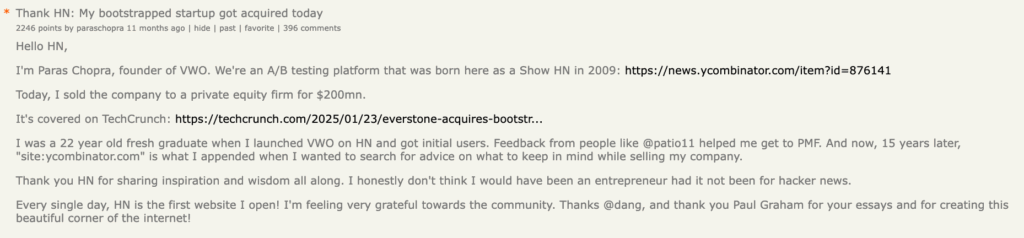
Post my exit, a couple of well-meaning, experienced entrepreneurs told me that I should gear up for depression. Apparently, it’s common for founders to feel lost when they sell their company.
But, no, for me it has been totally opposite. If anything, I feel Wingify’s exit may have triggered some latent hypomania inside me.
I suspect this is to do with the fact that I always had my hands full with multiple projects beyond Wingify. If you read my previous years’ reviews (above), you’ll see how I have been upto something or the other even before Wingify exit.
However, with Wingify exit, my mental bandwidth for “side projects” has now increased significantly and so is my ability to provide them with resources. This has given me a very expansive worldview that feels full of possibility.
📖 My book got published
Isn’t it a secret dream of all book lovers to see their own book get published? This year, that dream for me came true for me!
Harper published my book on the mental models for startup founders under the title “The Book of Clarity“.

When it launched for preorders, there was so much excitement that the Amazon page for the book crashed!
This book is a collab with my wife Aakanksha Gaur who did all the illustrations in the book, and working with her on the project made the whole process blissful It is because of her illustrations that the book spent many weeks on Amazon India as #1 in the Marketing and Entrepreneurship category.

The book is still going strong with an average rating of 4.7 on Amazon. I have several more books in me, but for now I’m happy that this one is out in the world as atoms (and not just bytes).
🔬 Started an AI lab called Lossfunk
In 2024, I had started an AI community in Bangalore called Turing’s Dream. This year, pivoted its focus to research and renamed it as Lossfunk. I did this because Turing’s Dream had started attracting people who wanted to build startups, but what I desired was intellectual stimulation. Post Wingify exit, I had was surrounded by temptations of “retiring” by becoming an investor/mentor and Turing’s Dream would have been a perfect launchpad for it, but I simply wasn’t enjoying topics such as product-market fit anymore ¯_(ツ)_/¯
Instead, what made me come alive was discussions on reinforcement learning, attention mechanism, manifolds, scaling laws and so on. Academia had always interested me; during my undergrad days I was doing research in computational biology and publishing papers. But Wingify happened soon after I graduated, leaving me no bandwidth to engage in science or research.
Now, I have the resources, bandwidth and motivation to build my own lab. So, I decided it’s best that I focus my energies into creating a lab that explores fundamental questions and that’s what Lossfunk is slowly turning into!
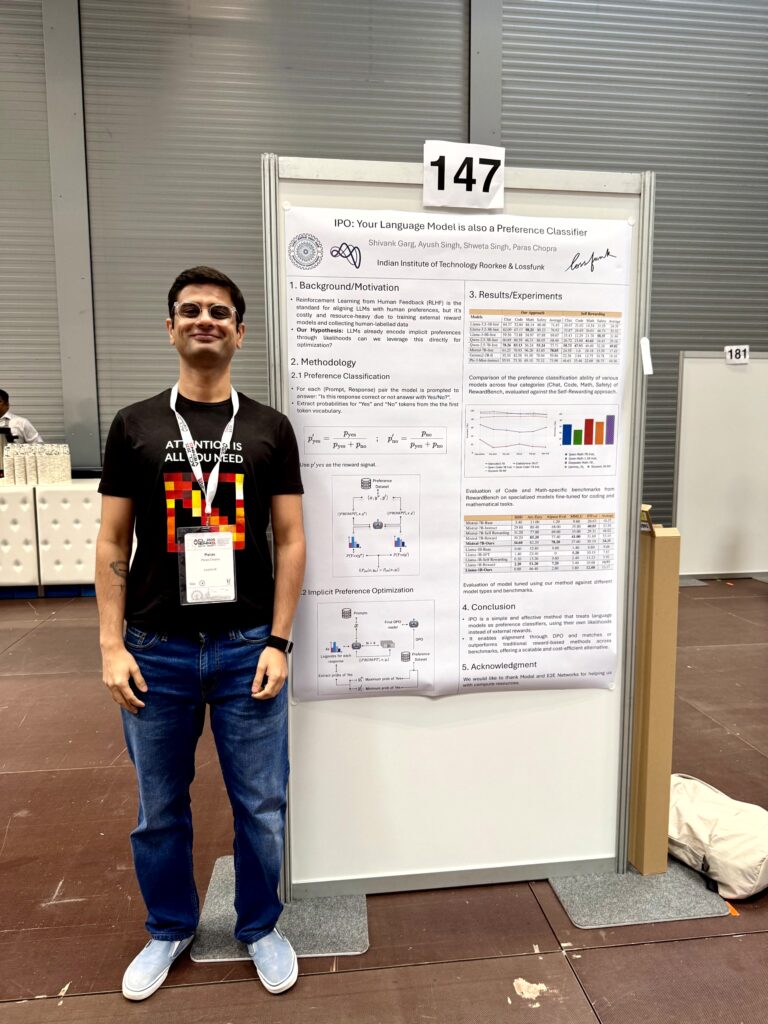
What excites me most about Lossfunk is that it’s like an open playground for curiosity, free of distorting incentives. Unlike industrial labs, we’re not building any specific product. And unlike academia, there’s no pressure to publish for the sake of it. There are no gatekeepers, and nobody to ask for permission. No VCs to answer. No committees to pitch to. We can – and will – ask any question that catches our fancy. We can (literally) just do things.
This is such an incredibly rare opportunity that I have to keep reminding myself of the uniqueness of what’s possible with it.
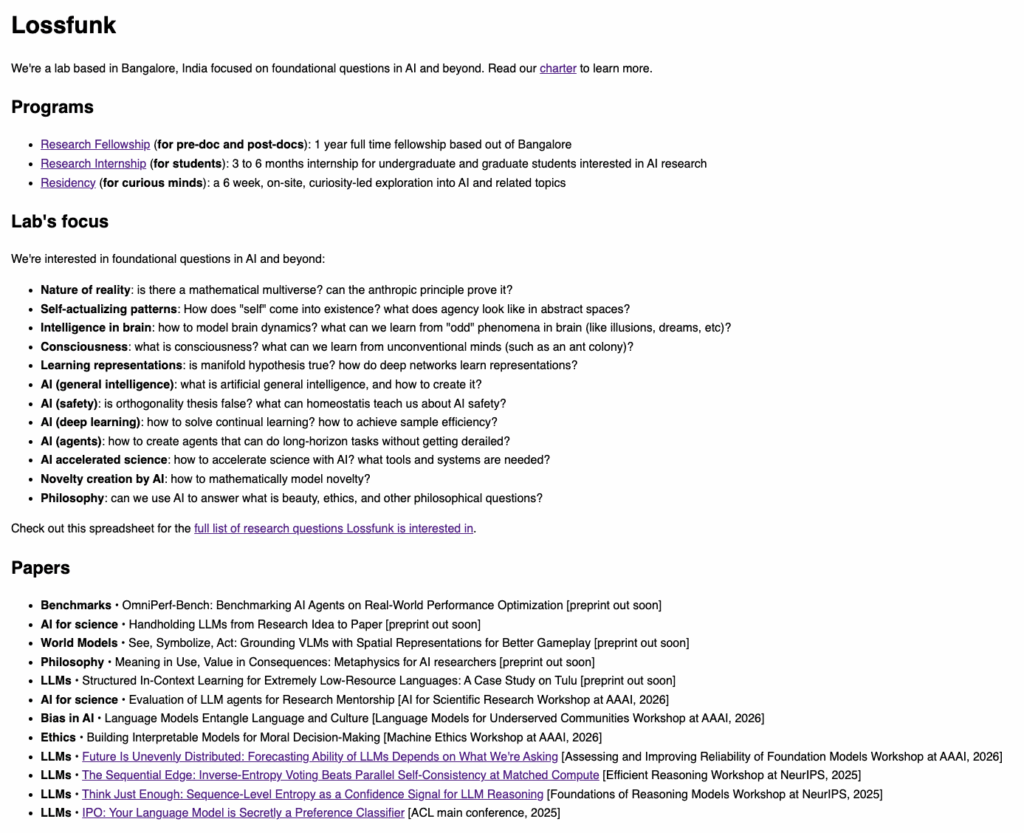
2025 was phenomenal for Lossfunk 🎉
All of my professional bandwidth was spent on Lossfunk, so here’s quick recap on what our lab did.
- We wrote 12 papers!
- Expanded the full-time research team to 23 people
- Ran 5 batches of residency with 100+ part-time residents
- Hosted 40+ offline events, attended by 1500+ people
- We now reach 10k+ people online
See full review here in this presentation.
🧐 Fully embracing Pragmatism gave me philosophical clarity
I’ve been a dilettante Pragmatist for a while now. But this year, I deep dived into nuances of it by exploring the ideas of philosophers such as later Wittgenstein, Quine, Dewey and William James.
It all started with picking up the biography of Wittgenstein from Vienna (where he was born). Digesting his ideas made me realize how many philosophical debates are simply due to confusion about language. Say, for example, the question: what is the origin of time? This particular question is not even wrong as the word “origin” in it is used wildly out of context. Of course, one can (and should) embrace the spirit of pragmatism and try to modify the question such that an empirical inquiry can give us an answer. Maybe a better question to ask is this: is there a purely relational version of physics that doesn’t require the concept of time?
But if we’re unable to pose an empirical question, the arm-chair philosophising devolves into a kind of a politics, where people just try to impress one another by clever sentence constructions. We ought to let reality decide correct answers to our questions, and where it can’t, we should be either inventive enough to pose better questions to it, or accept silence and uncertainty.
Incidentally, I just finished this excellent book on pragmatist philosophy of science.
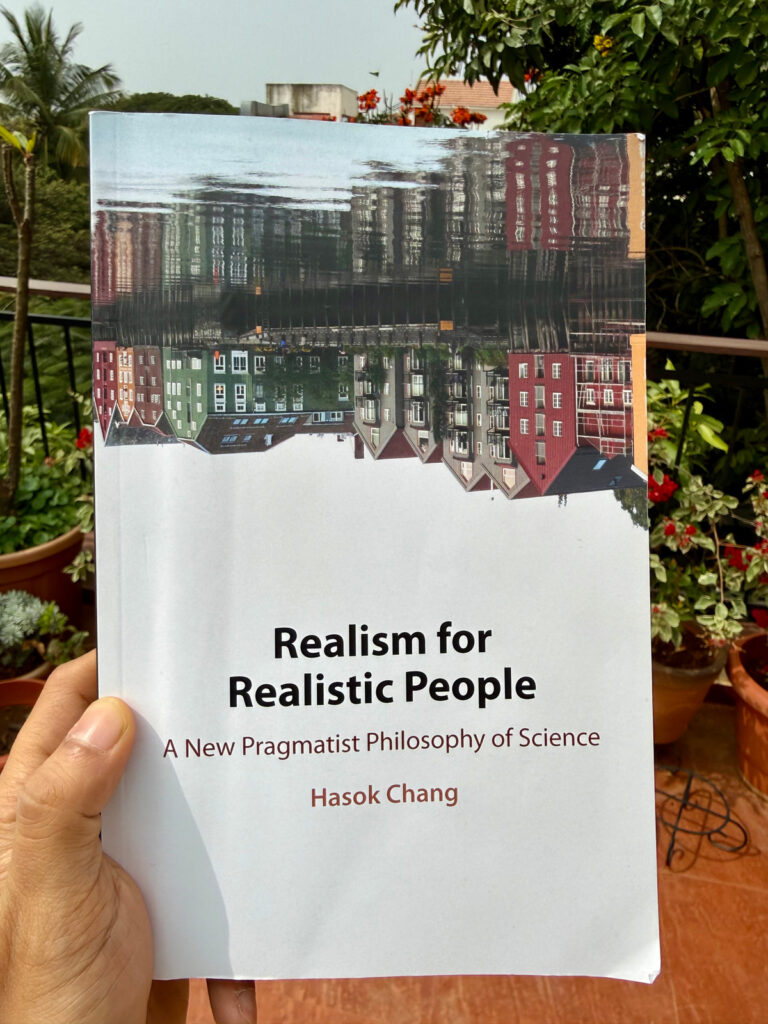
Some notes on reality, truth and pragmatism
– Reality is mind-framed but not mind-controlled. We can think about what is out there only in human-conceptual terms but what’s out there doesn’t depend on our mind
– Truth prior to being conceptualised by a mind is a nebulous notion. All we can think about is always within a framework. So, raw “reality” existing prior to conceptualisation is ungraspable
– Reality, then, is model-based and iterative. Our knowledge of it reality obtained when our ideas are tested in the world, confirmed by empirical investigation (making reality mind-independent)
– Pragmatism is about asserting that the only way to learn about the world is through experience, and hence all arm-chair theorising should bear some consequences in the world
– Our knowledge is action-oriented, and not just passive beliefs. We iterate on our when our actions bear new knowledge. That is, truth is whatever set of confirmed theories we have in our arsenal (and they’re true to the extent of their confirmation, making truth a quality instead of quantitative measure)
– Truth is also domain-dependent. Both Newton’s laws and general relativity are true, but in their respective domains. QM and relativity both work but are incompatible in overlapping domains. This shouldn’t be a concern as our reality is always mind-framed.
– Science doesn’t approximate “reality” as the word “reality” independent of human-conceptualization is ill defined. We simply get more and useful conceptual schemes as science progresses
– We can’t say our current best theories show us the truth as previous best theories were iterated upon and so can the current ones
– It’s better to have a plural notion of truth where a domain can contain multiple ways of looking at things vs insisting on one correct “platonic” version of truth. The former implies expansion of knowledge, latter implies convergence
– Science is simply a more rigorous way of everyday thinking: we iterate on our ideas by looking at what they do in the world
– Understanding something is building a model of it
– You can answer normative questions (of the nature what one ought to do) by taking a rigorous empirical approach. You can decide by looking at history of what people like you in similar situations have done and reported success/failure after
– Theories / models are compressed regularities of the world, so an empirically validated theory is as good as relying on historical data about what tends to happen
🧑🎓 Did a week-long summer course at Oxford University
Oxford University has an excellent roster of summer courses for adults. Both I and Aakanksha enrolled for a course there in July 2025. I studied Plato’s Republic, where we read parts of the book and discussed what it meant. Here’s my assignment that I submitted after finishing the course.
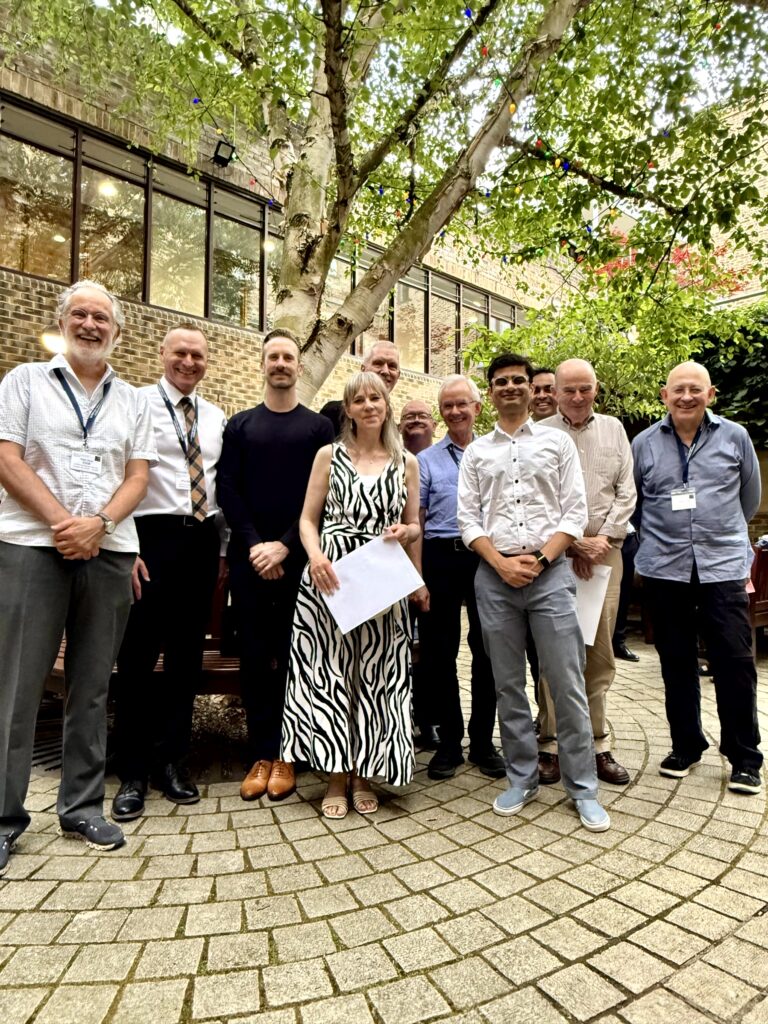
This was my first exposure to a top-tier university and thoroughly enjoyed the experience. (The excellent beer in the UK helped too!)
🥳 Insane amount of fun with friends and family
The moments I remember the most in 2025 are actually not about professional achievements at all. Instead, my highlights are things like walking leisurely with Aakanksha, dancing with friends, and having a quiet dinner with family. The more I age the more I realize that the meaning in life is being around people you love.
Took family and friends on trips with me
The best use of money that I’ve found is to organize trips and take your friends and family along. This year, I went to many such trips.

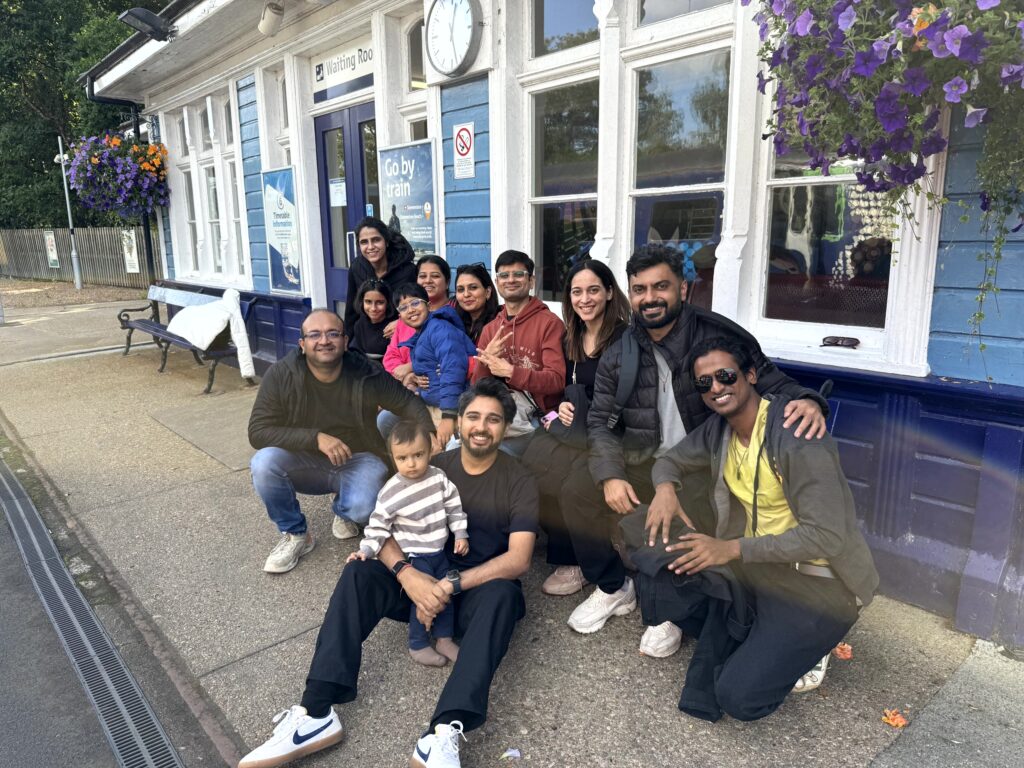
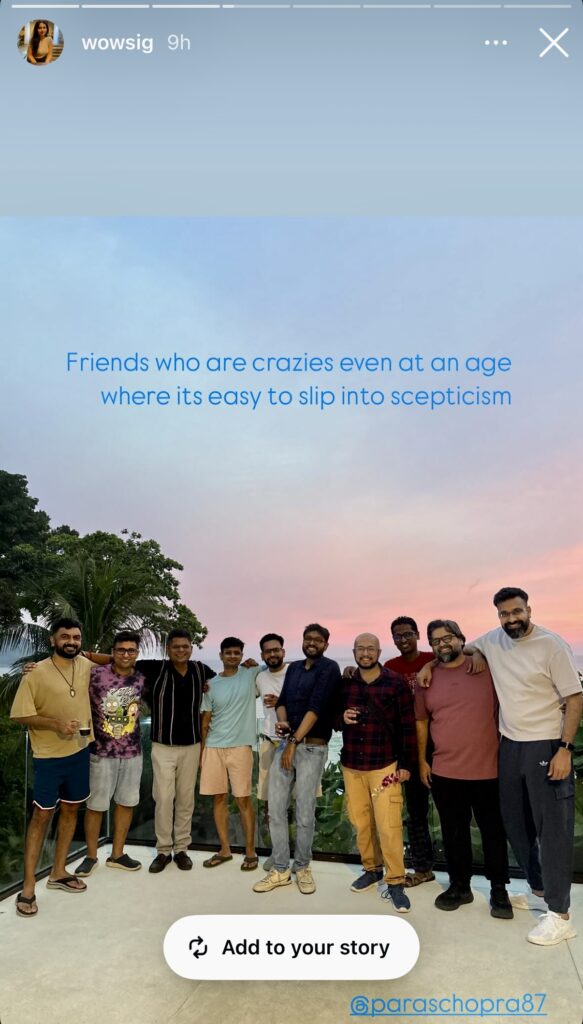


Aakanksha turned 40 and we had a blast!
This year Aakanksha turned 40 and, true to her spirit, she celebrated it by organising a reading retreat for all her friends. I can’t overstate how much of a blessing she is in my and many other people’s lives. Her subtle sensitivity about things that matter and her empathy for beings is a tremendous inspiration!

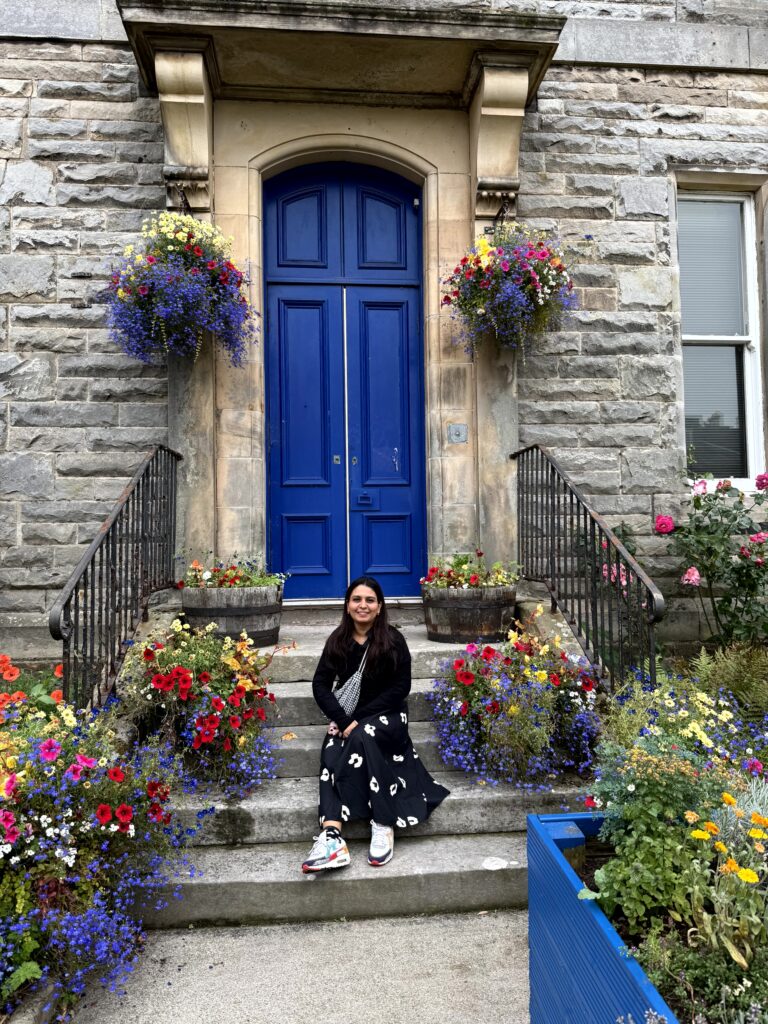
May she achieve all that she wants in her 40s!
Uncaring silly fun!
The video says it all. I made sure to keep reminding myself to not take anything so seriously, to not grow up into a boring adult and to keep playing without purpose.
🕺 Other miscellaneous highlights
- Read 30 books this year.
- Thought and wrote a lot on what research is and how to do it (primarily on Lossfunk newsletter)
- Worked out 5 days/week consistently and finished my first 10k run!
- Didn’t feel a need to continue my therapy sessions (as I felt much more in control of my emotional reactions)
- Actually, ChatGPT helped a lot here! I used it to reiterate and build upon whatever I learned during my therapy sessions in 2024.
Right now my state of mind is captured by what I wrote earlier this year: Don’t Compete. I now have zero drive to impress anyone, to seek approval from anyone or to enter into any competition. Life is so short that playing a finite game isn’t worth it at all. Instead of shrinking attention by competing with others, one can expand time by playing an infinite game where everyone has fun along the way. Life ought to be about non-zero sum games.
So, going into 2026, what’s on my whiteboard now? Well, here’s a literal picture I took just now.
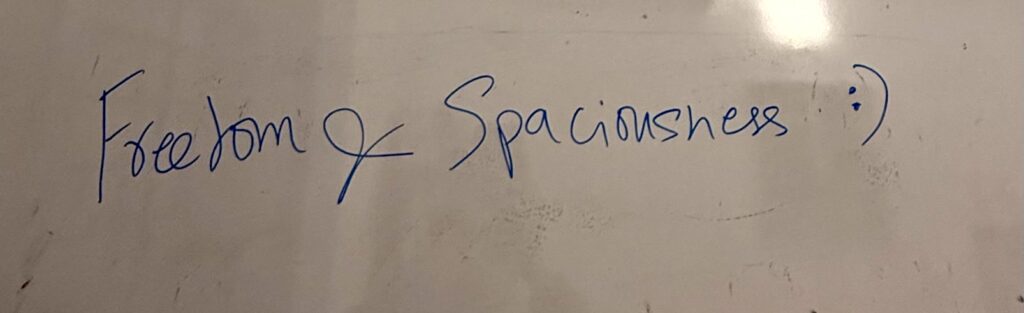
Yep, that’s it. In the coming year, I hope to cultivate a mindset full of curiosity, abundance, space, freedom and aliveness.
May you have a great 2026!
Join 200k followers
Follow @paraschopra