This essay is part of the series in which I talk about my learnings and insights building a habit coaching app (Nintee) in 2024. It didn’t ultimately work out because an app has marginal influence in a human’s life (v/s that of friends, family, culture and immediate environment). Most apps that work in the category operate like gyms (charge upfront when the motivation is high, and be okay with high churn). I had raised VC funding for it and later it became clear to me that this wouldn’t be a VC scale business, so I shut it down and returned the remaining funding. Hope the insights learned along the way would turn out to be valuable to others.
This series comprises of the following essays:
- Science of habit building: how habits are formed and broken
- Making a product that Marl loves: why well-intentioned apps ultimately become attention-seeking and gamified
- The two views of rationality: what is true v/s what is useful
- How does behavior change happen: frameworks and mental models for human behavior change
- How to coach someone (this one): 21 points to keep in mind while coaching someone
Subscribe to the blog if you want to be notified of future essays.
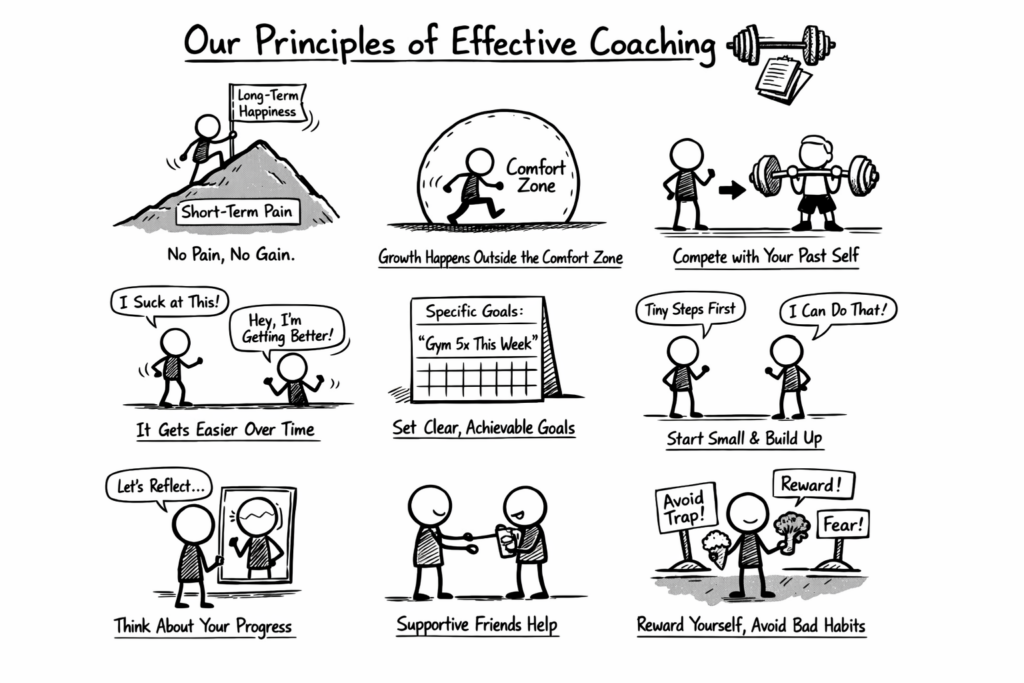
Through reading books (atomic habits, tiny habits, good habits/bad habits, elastic habits), papers and via our own 1-1 weight loss coaching pilot, at Nintee, we converged on following principles for effective coaching:
- Long-term happiness requires short-term pain ✅
- Everything worth doing in life requires stepping out of the comfort zone. If it were easy, you’d be doing it already.
- Change is a process, not an event ✅
- Nothing big happens in a few days, weeks, months or years. Focus on where you’re going, instead of where you’ve arrived.
- You’ll suck at it initially, but it’ll get easier over time ✅
- At anything new, you’ll suck and not be satisfied. That’s ok. Keep at it and it’ll start becoming easier over time.
- Your competition is your past self (not others) ✅
- Comparison with others is useless as the world consists of different players playing different games. Focus on yours, and get better at it.
- If you can’t tell when a goal is achieved, don’t bother keeping it ✅
- Don’t keep your goal as “being healthy”. Keep it as “going to the gym daily for the next 7 days”. The more specific your goal is, the more motivated you’ll be to nail it.
- You’re a mix of different people (some motivated, some lazy)
- You’re not a single person. Parts of you are motivated towards something, while other parts are lazy. Try recognizing which part is currently controlling you.
- No reflection = no progress ✅
- Progress of any kind requires an active involvement of the mind. By reflecting and thinking, you discover patterns (about yourself and the world) that are not at all obvious.
- Start tiny, increase difficulty gradually ✅
- Everything big starts small. For any new activity, start with something that’s easy for you to perform. Increase the difficulty level (a little bit) when comfort sets in.
- Don’t try more than ONE new change in life simultaneously ✅
- Too many changes at once will overwhelm you. Pritorize the one with the highest success chances. Once the first change is close to becoming a habit, pick the next one (and so on).
- When unmotivated, do something small (but do it) ✅
- When you push yourself to do something, the momentum of doing that activity creates its own motivation. So if you start by doing 1 pushup, you’ll find yourself doing 5.
- Do it consistently first, then worry about doing it well ✅
- Do something sloppily, instead of not doing it all because you can’t do it well. Consistency ensures that the activity becomes an ingrained habit and quality starts increasing automatically over time.
- Treat life like a game – commit to growth challenges, make it fun and celebrate when you win ✅
- Growth in life is a journey as long as life itself. Break big life changes into small, achievable fun, challenges. Keep celebrating all progress. Like a game, keep increasing difficulty level along with your mastery of it.
- All-or-none thinking is a trap
- Doing something is better than doing nothing at all.
- Make good habits easier to execute, bad habits harder ✅
- Want to drink more water? Keep a water bottle on your table at all times. Want to quit smoking? Throw away the cigarette pack.
- Increase the stakes for changing by announcing it publicly ✅
- To increase the chances of meeting your goals, put your reputation on stake by announcing it to friends and family
- To help someone, understand them first ✅
- Different people have different motivations and face different problems. Some people do fasting for weight loss, others do it for religious reasons. You can’t help them unless you get to know them first.
- Be curious about your mistakes, but forgive yourself ✅
- Think of your mistakes as learning opportunities, but quickly move on (no matter how big or small the mistake is). Nothing good comes out of self-hatred.
- Recognize how capitalism is keeping you addicted ✅
- Our economies are designed to make us addicted to various substances (porn, food, feed). If you can’t quit such addictions, don’t blame yourself but make sure you find ways to come out of such traps.
- Always use positive reinforcement, never include fear or guilt ✅
- The best way to change people is to reward them whenever they do what you want them to do. Give yourself a reward for your progress often. It can be as small as a mental pat on the back, or can be a day at the spa. Rewards literally rewire the brain to make difficult actions easy over time.
- We’re machines, and need repeated triggers to change behavior
- Stack new habits on top of existing habits. Without triggers, no behavior change is possible.
- It’s hard to change along, you need supportive friends. ✅
- If you’re coaching someone, talk to them like a friend would. Unless you’ve earned their respect, never be prescriptive (like a teacher or a mentor).
Join 200k followers
Follow @paraschopra