This essay is part of the series in which I talk about my learnings and insights building a habit coaching app (Nintee) in 2024. It didn’t ultimately work out because an app has marginal influence in a human’s life (v/s that of friends, family, culture and immediate environment). Most apps that work in the category operate like gyms (charge upfront when the motivation is high, and be okay with high churn). I had raised VC funding for it and later it became clear to me that this wouldn’t be a VC scale business, so I shut it down and returned the remaining funding. Hope the insights learned along the way would turn out to be valuable to others.
This series comprises of the following essays:
- Science of habit building: how habits are formed and broken
- Making a product that Marl loves: why well-intentioned apps ultimately become attention-seeking and gamified
- The two views of rationality (this one): what is true v/s what is useful
- How does behavior change happen: frameworks and mental models for human behavior change
- How to coach someone: 21 points to keep in mind while coaching someone
Subscribe to the blog if you want to be notified of future essays.
Following is an internal note that I had prepared while researching self-help industry and what can we learn from it for Nintee. I’m reproducing my notes verbatim. You’ll find phrases such as “we should do this” which indicate my mindset at that time.
Self-help has its own share of criticisms. It’s important to analyze them and see what our stance is. (Obviously, we will never do anything that directly increases suffering – it’s our mission to reduce it).
Lack of scientific evidence
Critics claim that many self-help methods lack scientific backing and rely more on anecdotal evidence or personal testimonials.
It’s important to distinguish between what’s scientifically true (traditional idea of rationality) and what’s empirically useful (the deeper view).
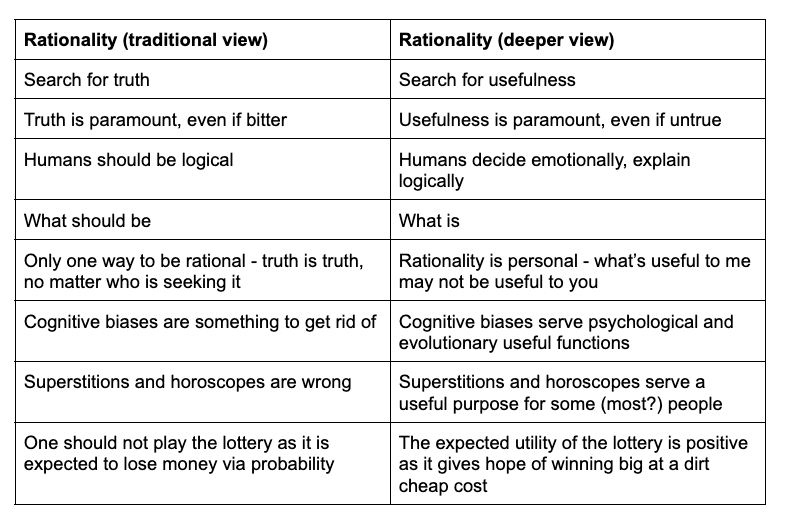
Many “unscientific” techniques are placebos and, like placebos, they actually help people. We need to be aligned what is empirically known to help people, instead of what is scientifically known to be true.
Overemphasis or quick fixes
Some argue that self-help books and programs often promise immediate results, leading to unrealistic expectations and disappointment.
This is a valid criticism but as long as we align ourselves with what’s empirically known to be useful, we will ensure that we don’t make a claim that cannot hold in practice. Also, one of the core components of our product is habit / goal tracker which orients towards actually acting on the advice.
Commercialization and profit-driven motives
The self-help industry is seen by some as more interested in making money than genuinely helping individuals, leading to a proliferation of questionable products and services.
There’s nothing wrong with commercialization (even therapists charge for their time). But it’s possible that perverse incentives can be set up in self-help where trust and authority is exploited for profit gain at the expense of the individual.
I think we can avoid such perverse incentives by having a simple subscription model which gives access to entire platform, so that we aren’t charging anything extra for “special” products or features (which can lead to a possibility of our advice twisting towards our profit, and not towards what’s helpful.
Oversimplification and one-size-fits-all approach
Critics argue that self-help materials often oversimplify complex issues and offer generic solutions that may not be applicable to everyone’s unique circumstances.
Obviously, this is our differentiator. We’re going to provide personalized self-help.
Blaming the individual
Some argue that self-help materials put excessive pressure on individuals to solely take responsibility for their problems, without acknowledging systemic issues or external factors beyond their control.
Our approach to self-help is that of positive-reinforcement. We would strictly NEVER blame the individual, but rather explain what circumstances could have led to the undesirable condition the individual finds herself in and how to get out of it.
Our differentiation: self-help made fun, structured and personalized
Nintee will make self-help fun, structured and personalized. We promise to deliver it by making a personal coach for every human being on the planet, and packaging it in an experience that’s extremely delightful.
Why focus on personalized?
People have unique needs in growth. But most self-help is done via books or courses, which are one-to-many mediums. The only one-to-one self-help available is therapy, which is often expensive and not sought because it has a stigma attached to it.
How can we make it personalized (and why the mainstream can’t)?
We will utilize AI/LLMs to make it personalized to specific individuals. The mainstream (mostly book/course publishers) don’t have expertise for this.
What does personalization include?
- Understanding user personality and adapting approach/advice accordingly
- Different people are motivated by different things and have different temperament. We need to adapt accordingly.
- Serving the long-tail of user goals
- Right from helping stop nail-biting to successful mid-career switch from a lawyer to a guitarist
- Anticipating user needs and addressing them proactively
- One to one focus would mean we anticipate what the user needs proactively
Why focus on structured?
Bite-sized self-help content is everywhere (on YouTube, Instagram, etc). Going through those scattered content leaves people confused. We will help them give a structured path so they can master a particular area of life skill. Books give structure but people aren’t reading them anymore.
This is similar to Duolingo. There’s lots of content on how to say hello in different languages, but for structured path to learn a language you need an app.
Why focus on fun?
Because people are more likely to engage with an experience that’s fun and delightful, v/s one that feels like work. Courses and books have a high abandonment rate because they feel like work. An experience that doesn’t feel like that has high retention (think of games, Duolingo, Instagram).
How can we make it fun (and why the mainstream can’t)?
Our hyperfocus on creating delightful experiences will create org capability over time. The mainstream (mostly book/course publishers) don’t have expertise for this, and it is difficult to hire tech-savvy designers in non-tech businesses.
How fun and personalized will help us attract customers
User experience does not have a ceiling – you can make it as good as you can. So, to attract the people interested in self-help to our app, we have to absolutely nail the UX. Our inspiration here is Duolingo which entered into an established category of language learning, and because of their hyperfocus on user experience, they won the market.
Today, anyone who wants to casually learn self-help downloads duolingo and uses it (instead of buying a book). We want to be the same for self-help: anyone casually interested in self-help should use Nintee (instead of buying a book).
Useful thumbrule
As we develop our app, we should look at each screen and ask ourselves: “does it look fun? Is it personalized?”
Sidenote: how existing industries/players get disrupted
There are two ideas that support our approach.
Disruption from the edges
Typically, a startup focuses on satisfying the needs of customers that are typically ignored by the mainstream players. These customers often have weird/extreme needs that the mainstream cannot fulfil. A startup addresses these and wins those initial customers and slowly iterates its way to the mainstream customers who adopt the startup’s solution later. The mainstream ignores the startup initially because it looks like a toy focused on customers who are not their focus. By the time mainstream notices what happens, the startup is big enough.
A simple example of this is early cloud providers. They were satisfying the need of extreme customers who wanted on-demand software (while the rest of the world wanted on-prem software). These early cloud providers seemed like a harmless toy, but over time iterated their way to the mainstream.
The important aspect here is that a startup has to differentiate from the mainstream on clearly marked attributes, attracting customers who appreciate those attributes. There is no point competing head to head and attracting the average customer because she is already satisfied with the mainstream options. In our case, our differentiation will be on three dimensions: fun, structured and personalized.
Read more about this idea here and here (quote from this book).
Which dimensions to pick for differentiation is an important consideration. Not any two dimensions are equally important. It matters what you choose to differentiate on. If you differentiate on dimensions that humans naturally prefer to move towards, you win. Otherwise, you lose.
In our case, we have high conviction that people will prefer personalized experiences, so if we provide that, it’s a net value add. We also have high conviction on the importance of user experience and making it enjoyable and fun. This conviction comes from the fact that there’s no upper-limit of UX and people always prefer a better UX over a worse UX (in fact, Apple’s premium is entirely dependent on this).
Who is Nintee not for?
Nintee is for those who are casually interested in self-help or growth by learning broad, horizontal life-skills.
So, Nintee is not for those:
- People with clinical mental health issues
- They require therapy from certified professionals
- Nintee is for casual self-help enthusiasts, anyone for whom downstream consequences for not getting sufficient help are immense, we’re not for them
- Just like Duolingo is for casual language learners. If your job depends on learning a language
- Who don’t seek self-help at all / non-growth minded
- Stability seekers (those who want to maintain status quo)
- Risk-averse (those who dont want to go outside comfort zone)
- Pleasure seekers (self-help requires short term sacrifice)
- Family-oriented (those who derive bigger joy from family/friends v/s self-growth)
- Those who are skeptical of self-help
- Many skeptics exist who believe self-help doesn’t have value, and exists for fooling people. We can’t help such people
- Those who require in depth skills
- Nintee is not for those who want to learn coding for career, but is for those who want to think like a programmer
Emotional v/s functional needs
Products fulfil two kinds of needs: emotional or functional. Functional needs are utilitarian (e.g. calling a taxi via Uber). In such cases, product is a means to an end. Emotional needs require fixing a bad feeling or elevating to a good one. Products that fulfil emotional needs are an end to themselves (e.g. a good music track, or a game). Many products fulfil both (e.g. Instagram can serve a functional need of being a platform for brand, but also an emotional need for social validation).
At Nintee, we will fulfil both emotional and functional needs, but be biased towards emotions. The reason for this is simple: functional needs are already fulfilled by the internet. To grow in life, you have all the information in the world. It’s just doing it is very difficult, and hence there’s a requirement for something to fulfil the emotional need of growing.
Top 3 emotional needs in the casual self-help market
These needs are ultimately derived from basic psychological needs:
- Instant gratification
- Aesthetically pleasing experience
- Relatedness / community
Top 3 functional needs
- Convenience
- Low-time commitment
- User-friendly design
How does self-help benefit
At a meta-level, here’s what self-help benefits people from:
- Self-efficacy and confidence: the confidence that they can get things done, which creates a positive feedback loop of actually doing things
- Structured tools for life skills: a way to get things done
- Accessible info: easy to consume information instead of academic jargon
- Social support: communities form around key ideas in self-help and people gain identity from it
- Experimentation ground: variety of techniques for people to experiment with to see what fits them best
- Placebo satisfaction: feeling that they’re taking effort towards improving their life is good enough for most people
Most common self-help needs
What people are looking for in self-help can be assessed by top self help books of all time. These can be categorized into following categories:
- Stress & Anxiety Management
- Self-esteem & Confidence Building
- Goal Setting & Productivity
- Relationship & Communication Skills
- Career Advancement
- Mental Well-being & Mindfulness
- Physical Health & Fitness
- Personal Finance & Wealth Management
- Spiritual Growth
- Personal Identity & Self-Discovery
(This corroborates with replies to my tweet)
What motivates people seeking self-help
It is significantly similar to what motivates humans. These motivations are simply applied in a different context
Gaining trust as a prerequisite for winning in self-help
Any time we’re talking about helping people, the first question in people’s mind would be: “why should I trust you / this advice?”
So, gaining trust becomes paramount in the coaching / self-help industry. People would be constantly asking: “can they deliver results? Do they know what they’re talking about? Should I trust them?”.
There are various ways to gain trust, and we must do whatever it takes to establish trust:
- Instant gratification that feels personalized
- Testimonials
- Coaching requires time for results, so testimonials become paramount
- Research
- For scientifically minded people, show what you’re talking about is backed by evidence
- Expert sources
- Cite expert sources
- Data privacy
- Since this is an app, we ought to be very vigilant about user data. If there’s a data mishap, we won’t recover from it
- Hallucinations
- If AI hallucinates something that’s untrue, we lose trust
- Harmful advice
- If AI gives harmful advice, we are in legal, business and moral issue
Aligning our product roadmap
- Goal tracking and coaching -> aligns to acting towards goals
- Learning -> aligns to new knowledge and skills
- Advice -> aligns to giving immediately useful advice
Zooming in: early audience
At the start, we’re targeting people who want to break bad habits and build good ones. We will iterate from there.
We will utilize the science of habit building for nailing this aspect.
Join 200k followers
Follow @paraschopra