Profit overpowers ethics, if left unchecked

We have seen our beloved companies transform into greedy and heartless entities over a period of time. Why does it happen?

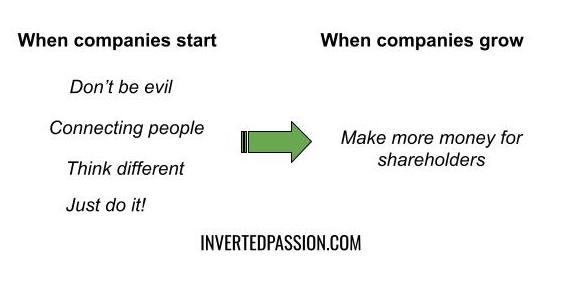
Just like individuals, companies are idealist when they’re younger and pragmatic when older

It’s usually not because founders have had a change of heart and they start loving money more than anything else. What typically happens is that incentives in an organization gradually start exclusively prioritizing profits.

This process typically begins when a company raises investment from professional financers like banks or VCs. The number one job of investment professionals is to get a return on their investment. It’s not that investment professionals don’t care about anything else, but if their job exists to make more money from money, that’s what they’ll do. With professional investors onboard, whatever a company does then is seen from the lens of the return that investors can get.  ...  Read the entire post →

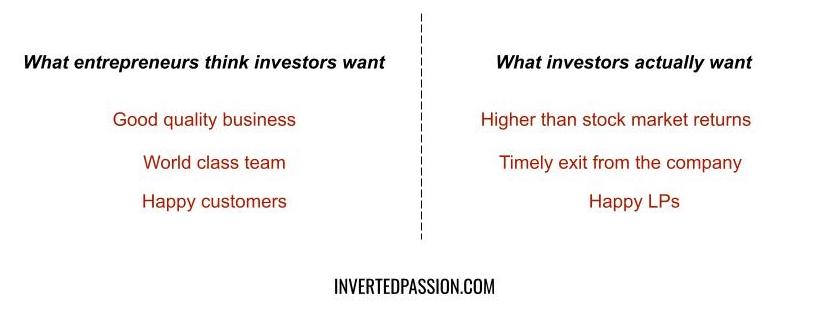
Investors will prioritize financial returns over your ambitions

Investors like talking about what makes a good business. You’ll find angels and VCs on Twitter constantly talking about what makes a good team, how to get product-market fit, and many other such aspects of startups.

Conflict happens when an entrepreneur’s motivation misaligns with investors’ motivation

Given the amount of preaching that the investor community does, it is understandable then that many first-time entrepreneurs end up believing that the VC community invests in companies in order to make them better.

There’s some truth to it as investors are incentivized to see their companies improve. But investors invest in a company to get a good financial return in the company. This is a trivial observation but it can be easily overshadowed by the apparent we-exist-to-help-entrepreneurs gyan that is ever pervasive in the VC land. Perhaps the world would be a better place if most VCs openly talk about their own incentives rather than talking about what businesses should be doing. ...  Read the entire post →

Business quality is determined by one metric: return on invested capital

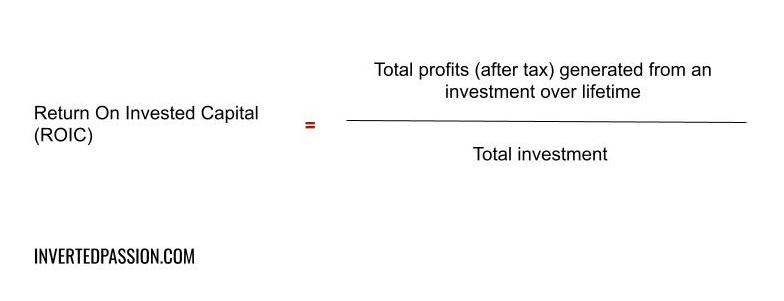
The financial purpose of a business is to generate over its lifetime a higher return for its shareholders than what they would have gotten by investing in risk-free options (such as government bonds).

ROIC: one metric to rule them all

Imagine there is an entrepreneur with a business proposal and she requires $100 as the initial investment. She reaches out to you and pitches her idea to seek your investment. To make a decision, you’ll probably analyze and estimate how much return you’d get in return for the money you give to her. If you usually get 6% interest annually in a savings bank account (which happens in India), you would expect a higher return than that from the entrepreneur (especially since there’s a risk of losing your entire $100 while your money in the bank is virtually risk-free).  ...  Read the entire post →

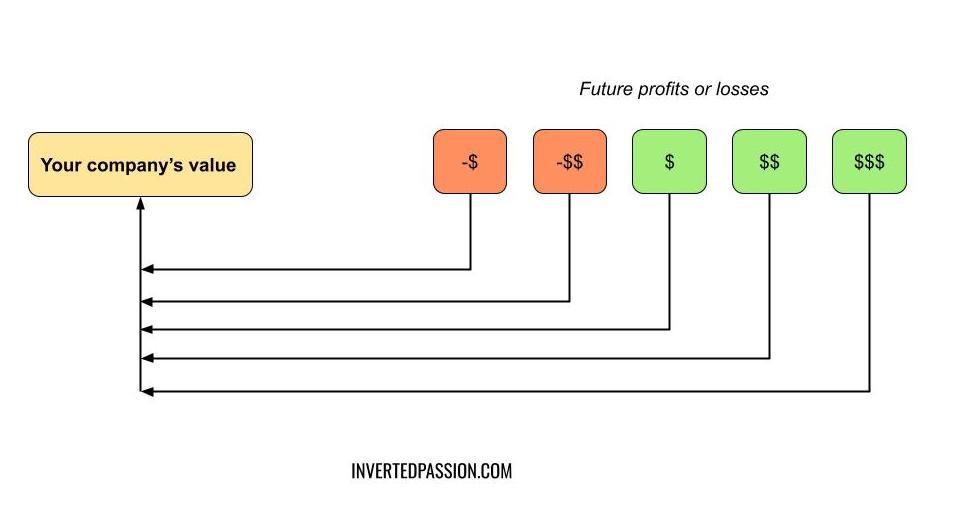
Your business is worth all future profits it is expected to generate

It’s easy to get bewildered by the billion-dollar valuations of startups that are operating under heavy losses. If you’ve ever wondered why would anyone pay for a company that’s not making any money, you’re not alone.

It pays to study how financial assets are valued

Early in a company’s life when there is much uncertainty about its future, the valuation process is more of an art than a science. However, it’s not a blind science. No venture capitalist will just hand over money to you because they like you.

Valuation, even when it’s an art, is grounded on a very simple financial principle that an asset is worth discounted profits it is expected to produce over its lifetime. The term discounted means that the cash in the near term is more valuable than the cash in the long term. It’s easy to can find the exact formula for calculating the discounted cashflow.  ...  Read the entire post →

Recruit exceptional people by showing them a promised land

A recruitment strategy should be indistinguishable from a marketing strategy. Entrepreneurs end up spending a lot of time understanding the market, talking to customers, building personas, and customizing their marketing messages to customer segments. However, they often fail to realize that recruiting people to work for you is no different from recruiting customers to use your product.

To recruit exceptional people, you have to first understand what drives them

It’s true that the key difference is that you’re asking for money from customers while you’re offering to pay money to prospective employees. However, for exceptional people, the money offered is a commodity because many other companies are offering them the same or higher money. Exceptional people never look for jobs; jobs look for them. ...  Read the entire post →

Moats for deeptech startups

I’ve written earlier that startups shouldn’t solve technically challenging problems. I still maintain the same view but wanted to add an important caveat to that claim.

The caveat is that startups shouldn’t exclusively rely on a specific technical innovation as their main advantage. I’m talking about narrow technical innovations such as making a better internal combustion engine, cheaper glue, and so on. Startups generally protect such specific innovations via patents but they’re not sufficient protection and hence quite weak as moats. ...  Read the entire post →

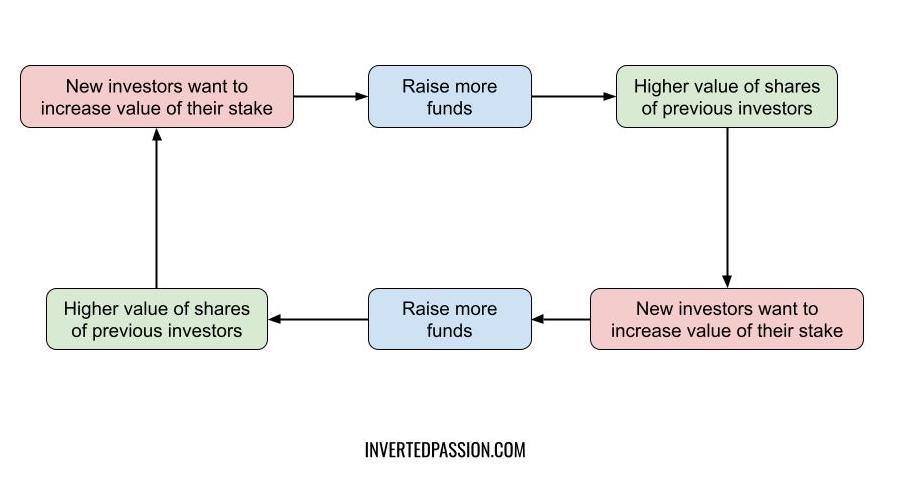
Raise funding by showing how you can raise even more funding

Fundraising is an exercise in demonstrating how your company can generate financial returns for the investor.

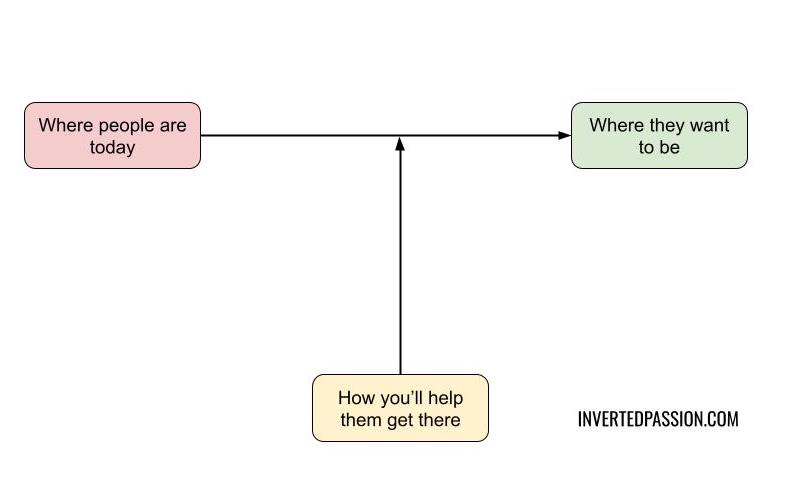
Investors are interested in their returns. Tell them how you’ll help them get it

Different types of investors have different risk-reward expectations and that’s why they end up specializing. For example, a bank as an institution is risk-averse. They’re okay with a relatively smaller return (marginally more than the risk-free return) but they want to make sure that such return is guaranteed.

On the other hand, funds specializing in seed-stage funding know that most of their investments will fail, and hence to cover for those duds, they expect to fund only the opportunities which can generate 100x returns. The few 100x returning opportunities and most of the others not returning anything means that on average they end up generating a decent financial return on their entire fund. ...  Read the entire post →

Get press by giving journalists something surprising

Journalists don’t get excited about new products and features the same way an entrepreneur gets.

This is because:

  • First, a journalist gets hundreds of pitches every day and a particular product launch announcement is no different than the many hundreds of launch announcements sitting her inbox.
  • Second, aliens visiting Earth is news but your product’s new feature is certainly not news. 

News is something that caters to basic human curiosity about the new and surprising. There is a reason why one death in a tragic car accident gets covered as news but thousands of deaths every day due to preventable diseases in poor countries don’t make it into the news. The former is surprising. People want to know how that particular accident happened. The latter is a statistic, a daily occurrence that people are familiar with and after a while becomes pretty boring to read. ...  Read the entire post →

How my 2021 went

At the closing of the last decade, I reviewed the intellectual progress I had in 2010s. Then I reflected upon the year 2020 by writing 20 lessons I learned in that year. Such reflections haven’t been part of any process – I’ve simply enjoyed taking a pause and doing stock of where my time went. Since time is the only limited resource we have, as I’m aging, I’m realizing that being conscious of how it’s getting spent is extremely important. In fact, such reflections are a fantastic way to nudge your future into a direction that you intentionally choose (v/s reacting to circumstances and drifting from year to year). ...  Read the entire post →

Consumers want to conform, companies want to differentiate

Most consumers at any given moment are more or less satisfied with what they have. Since we’re creatures of habit, we tend to go to the same restaurants that we like, buy the same stuff as we’ve always done and live our days without significant deviations. We’re less exploratory than we’d like to think.

This is because there’s a cost of change. Whenever we are trying a new product, we’re incurring a cost (of effort, time, or money). And, we go to great lengths for avoiding these costs.  ...  Read the entire post →