AI is challenging what words mean

“Math” is not what it used to be anymore

I feel AI is breaking our usual, shared understandings of what words mean.

For the first time ever, we have a new kind of cognitive labor that isn’t humans, and that’s breaking norms for what we’ve forever implicitly assumed to be universally true. All our assumptions about how a domain comprising mainly of human activity is due for sudden shattering.

e.g. With Jacob’s conjecture shown to be false using an AI, my twitter timeline is full of both sentiments: “mathematics is done”, and “maths is just getting started”. ...  Read the entire post →
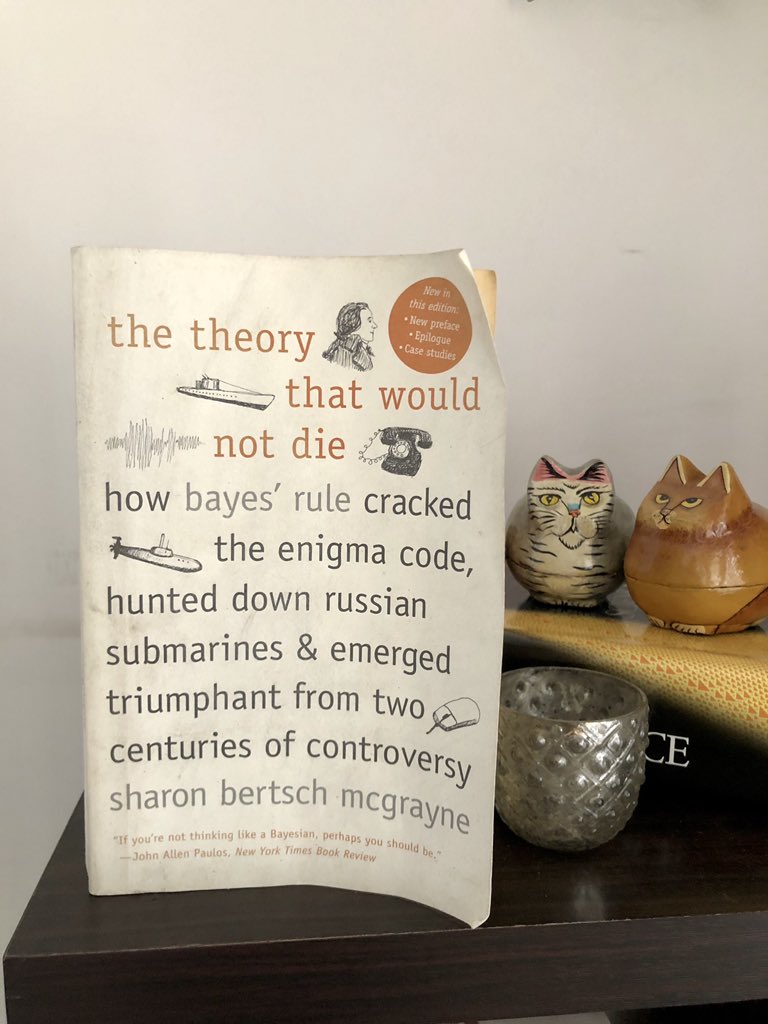
How to be a Bayesian

Just finished this book on the history of Bayes theorem and I highly recommend it.

In case you’re wondering what is it, keep reading.

(A thread on Bayes theorem)

1/ Statistics is all about calculating probabilities, and there are two camps who interpret probability differently.

Frequentists = frequency of events over multiple trials

Bayesians = subjective belief of the outcome of events

2/ This philosophical divide informs what these two camps usually bother with.

Frequentists = probability of data, given a model (of how data could have been generated)

Bayesians = probability of model, given the data

3/ Most often we care about the latter question.

E.g we want to know given that the mammography test is positive, what is the probability of having breast cancer.

And not given breast cancer, the probability of test being positive.

4/ These two questions sound similar but have different answers.  ...  Read the entire post →

Simpson’s paradox, or why your intuition about averages is probably wrong

I came across Simpson’s paradox in Judea Pearl’s book The Book of Why. It completely changed the way I thought about average statistics such as mean, standard deviation and correlation.

Inspired by that, I explored Simpson’s paradox in a 10-minute video.

I hope you enjoy the video. Leave your comments on Youtube (or on an email to me) if you have feedback.